How To Create New User in RHV-M GUI Access | Arkit
After installing the RHV-M you wanted to create user and provide him an access either Read-Only or Administrator access, but how to create new user in RHV-M GUI Access. Let’s see the procedure.
How To Create New User in RHV-M
AAA-JDBC is an extension which allows to store authentication and authorization data in relational database and provides these data using standardized oVirt AAA API similarly to already existing AAA-LDAP extension.
Login to RHV-M Command Line using SSH (As a root user)
Create the user using below command
# ovirt-aaa-jdbc-tool user add user1 --attribute=firstName=RaviKumar
- user1 = Replace the user name which you wanted to create.
- Update the firstName as well

rhv-m user
Reset the user password
# ovirt-aaa-jdbc-tool user password-reset user1 --password=pass:redhat

reset user password RHV-M
Unlock the user at the first time otherwise you will get below error
unable to log in because the password has expired. <a href=’/ovirt-engine/sso/credentials-change.html’>change the password</a> to proceed.
# ovirt-aaa-jdbc-tool user unlock user1
Check the user details Like User password validation, user is locked and user is enabled
# ovirt-aaa-jdbc-tool user show user1
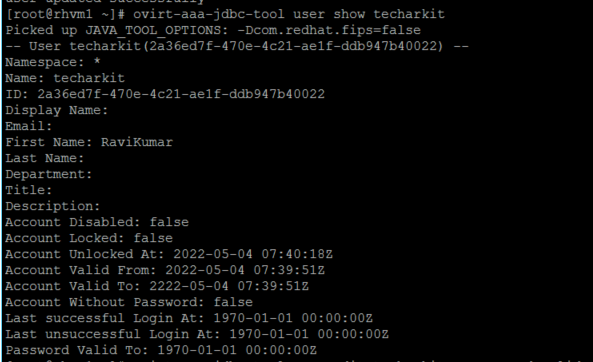
As you see in above screenshot user password is not valid with current date, we have to update, use below command
# ovirt-aaa-jdbc-tool user edit user1 --password-valid-to="2022-12-31 23:30:53Z"
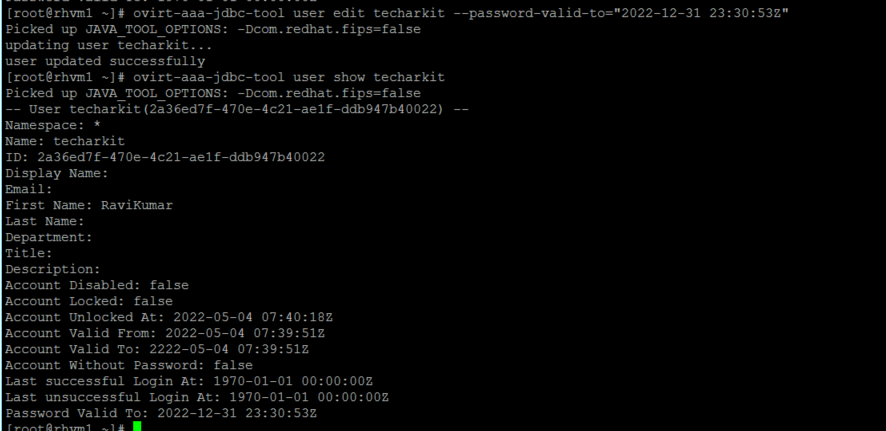
After user creation from Command Line you have to go to Web UI in-order to provide the access to the user
Login to RHV-M Web UI then login to Administration portal then navigate to Administration –> Configure –> Add
Enter the username in the empty box then click on Go
Select the user (tick mark)
Select the role from bottom role list – Click OK.

That’s it, you successfully created the user.
Related Articles
Virtualization Software in Linux
Virtual Desktop Infrastructure
Thanks for Your Wonderful Support and Encouragement
More than 40,000 techies are part of our ARKIT community. Join us today and keep learning Linux, Cloud, Storage, DevOps, and IT technologies.